

Super Staples recipe book by Wild Groats, paperback edition
Super Staples recipe book open to strawberry gluten-free muffin page with fresh muffins and Wild Groats bag

SUPER STAPLES (Paperback)

Regular price$17.99
/

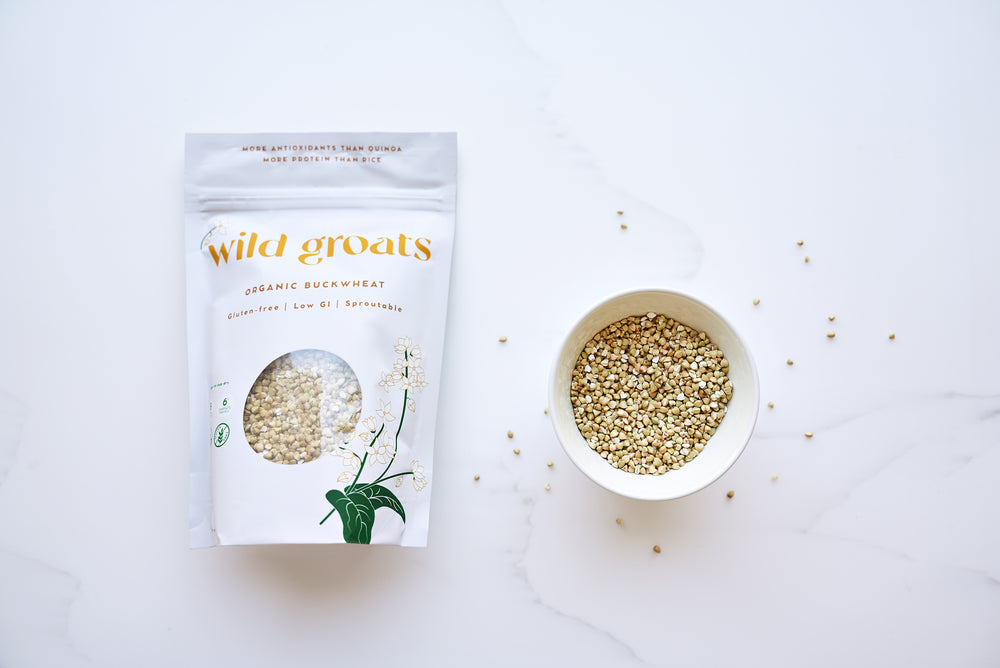
Transform Your Kitchen with WILD GROATS™ organic buckwheat groats – The Ultimate Superfood Staple

Healthy cooking doesn't have to be complicated. Super Staples is your guide to getting the most out of WILD GROATS™ organic hulled buckwheat—a single ingredient that's simple, versatile, and nourishing.

Naturally grain-free, gluten-free, and low glycemic, WILD GROATS™ buckwheat groats are packed with complete protein and essential minerals, giving you steady energy without the crash.

In this book, you'll find 30+ approachable recipes that make it easy to:

  • Sprout for maximum nutrition
  • Cook as a hearty rice alternative with 3x the protein
  • Blend into gluten-free flour for everyday baking
  • Add to salads, soups, and bowls for extra texture & nutrition

This isn't about learning complicated techniques—it's about discovering how one humble staple can support your health, simplify your cooking, and fit seamlessly into your everyday meals.

WILD GROATS™ buckwheat groats are already a daily favorite in kitchens across the country. Now you'll have the recipes to enjoy them in yours.

order on amazon button

FAQs

Even though it's called "buckwheat," it's not really related to wheat at all and doesn't have any gluten.

Buckwheat is usually considered a grain, but it's actually a seed! It comes from this plant called Fagopyrum esculentum. Buckwheat has similar properties as a grain, which is why it is considered a grain alternative like quinoa. You can do lots of things with WILD GROATS™ organic buckwheat groats, like turning it into flour, making porridge, or using it instead of rice or other grains in your cooking.

Raw buckwheat groats are more versatile in our opinion! They can be sprouted and blended easily into flour while toasted buckwheat cannot be sprouted and is typically not used for flour. Raw buckwheat has a mild nutty and slightly earthy undertone, while toasted groats (also known as kasha) bring a distinct nutty and hearty flavor. WILD GROATS™ buckwheat groats can easily be turned into Kasha by toasting them in the oven or stovetop.

Absolutely! WILD GROATS™ organic buckwheat groats is a complete protein source (contains all 9 essential amino acids)

Whether buckwheat groats are suitable for a paleo diet depends on the person's viewpoint.

The paleo diet focuses on foods our ancient ancestors ate, like meat, veggies, fruits, and nuts, while avoiding grains and processed foods. Some paleo followers avoid buckwheat because it wasn't eaten by ancient people and contains lectins. However, others include buckwheat in their paleo diet because of it's high nutrition profile (rich in protein, vitamins and minerals), is not a grain but a seed, and is gluten-free.

How to cook organic buckwheat groats:

Rinse buckwheat groats with filtered water using a fine mesh strainer. Optional: soak for 20+ minutes for easier digestion.

Bring 1Âľ cups water to boil with a pinch of sea salt. Add 1 cup groats, reduce to gentle simmer, cover partially and cook 10 minutes until water is absorbed.

Remove from heat, let sit 5-8 minutes. Fluff with fork and serve.

Cooking ratio: 1 cup groats to 1¾ cups water Total time: 15-18 minutes

Check out our full instructions on how to cook WILD GROATS™ buckwheat groats HERE.

How to make gluten-free buckwheat flour at home:

Transform your organic buckwheat groats into fresh, nutrient-rich flour in minutes! Homemade buckwheat flour is naturally gluten-free and perfect for pancakes, muffins, and bread.

Simple method: Add WILD GROATS™ raw buckwheat groats to a high-speed blender or food processor. Blend in short pulses until you reach your desired fineness - from coarse meal to fine flour powder.

Pro tips:

  • Use completely dry groats for best results
  • Blend in small batches (1-2 cups) for even texture
  • Sift through fine mesh for ultra-smooth flour
  • Store in airtight container for up to 6 months

Flour yield: 1 cup groats = approximately 1 cup flour 

Best uses: Replace up to 25% of regular flour in recipes, or use 100% for gluten-free baking

Fresh buckwheat flour has a mild, nutty flavor and adds protein and fiber to your favorite baked goods. Much more nutritious than store-bought flour!

We frequently update our blog with new recipes HERE.

We also share our ALL-TIME FAVORITE WILD GROATS™ buckwheat groats recipes in our recipe book 'Super Staples' HERE.

Rinsing buckwheat groats before cooking is not required but is highly recommended. Even better is soaking buckwheat groats in clean, filtered water for a minimum of 20 minutes, then rinse well afterward using a fine mesh colander or sieve. We recommend this because, like many seeds, nuts, and legumes, buckwheat groats contain phytic acid, an enzyme inhibitor that reduces the ability for nutrients to be absorbed. Through rinsing or soaking, this will naturally break down the phytic acid and deactivate the enzyme inhibitors, improving nutrient absorption and digestibility.

Sprouts are high in fibers, micronutrients, and phytonutrients and have higher concentrations of vitamins and minerals than the non-sprouted or cooked versions.

When eaten raw, they are richer in enzymes, making them more digestible and increasing the bioavailability of their nutrients. They are also low in calories, leaving you feeling lighter and cleaner. WILD GROATS™ buckwheat groats are known for being rich in antioxidants, and sprouted buckwheat groats are even higher in antioxidants and minerals such as magnesium.

When it comes to conventional grains (rice, wheat, corn, oats)... YES! Buckwheat groats outperforms conventional grains on almost every measure of healthfulness. Packed with vital minerals and nutrients, and a complete protein source (containing all 9 essential amino acids), WILD GROATS™ buckwheat groats is a whole-food version of a multi-vitamin.

Looks like an unhulled buckwheat seed snuck it's way into your bag! Little rascal ;) Not to worry, you can simply pick it out and toss it. Or if you accidentally cooked it, its perfectly fine to eat as the outer shell of the groat (which gives it its darker color) softens and is chewable once cooked.